


Clinically reviewed by Gordana Čižmek, specialist orthodontist · Prices and public information checked August 2026 · Updated September 2026
Invisalign treatment abroad is often advertised as much cheaper. But orthodontic treatment is not a single procedure that ends when you leave the clinic. It usually lasts for months, requires follow-up appointments and may need refinement aligners. The useful comparison is therefore not simply “Which country has the lowest advertised price?” but “What is the total price for equivalent treatment, and can the provider supervise it safely until the end?”
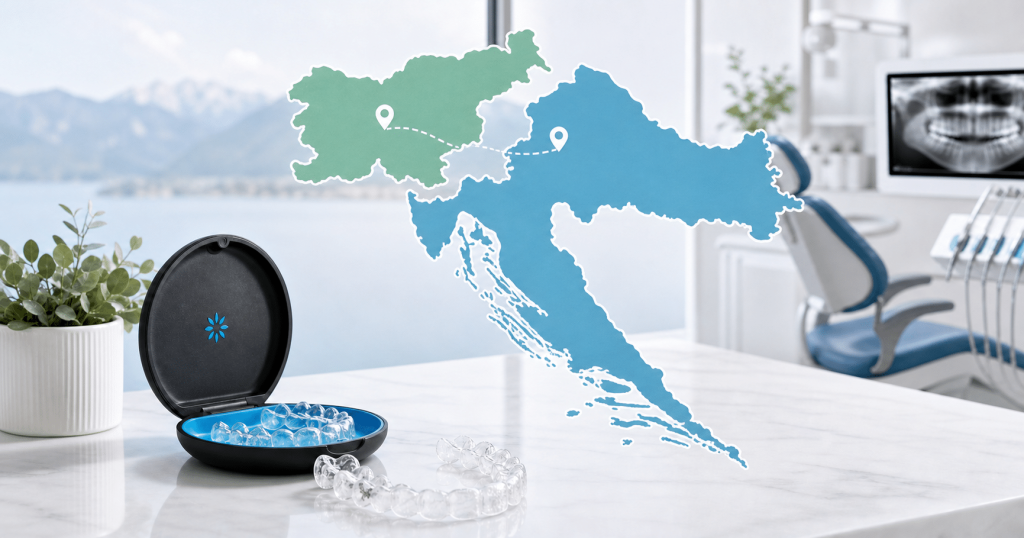
For a concrete comparison, the Slovenian article on which this guide is based reviewed the publicly listed prices of one established Croatian clinic, deliberately left unnamed. Its published range for full treatment of both arches was €2,600–€4,200. OrthoDental’s current listed price for Invisalign Comprehensive in Slovenia is €4,000. The ranges overlap: Croatia can be cheaper, but it is not automatically cheaper.
The short answer
- Published treatment price: OrthoDental Comprehensive is €4,000; the one Croatian clinic used for comparison listed €2,600–€4,200.
- Equivalent scope: compare the same package, both arches, controls, refinements and retention—not an entry price “from” a low number.
- Travel: Invisalign treatment commonly lasts 6–16 months and involves repeated controls, so distance matters.
- Total cost: travel, time away from work, replacement aligners and refinements can reduce or remove an apparent saving.
- Supervision: the orthodontist’s diagnosis and digital plan matter more than the country or the plastic alone.
Why do people consider Invisalign abroad?
The reasons are understandable. Some patients are trying to avoid long public orthodontic waiting times. Others see an attractive headline price online. For people living near a border, a clinic in another country may also be geographically convenient.
Zagreb is close enough to Ljubljana for repeated travel to be possible. More distant destinations such as Turkey or parts of Hungary can look inexpensive in an advertisement, but Invisalign is not comparable to a one-off cosmetic procedure. A comprehensive plan can require a consultation, diagnostics, delivery appointment, regular controls, rescanning, refinements and retention.
This article does not argue that treatment in another country is inherently unsafe. Excellent orthodontists practise in Croatia and elsewhere. The practical warning is narrower: do not begin a long treatment with a clinic you cannot realistically return to when an attachment comes off, an aligner does not fit or progress differs from the digital plan.
What Invisalign really costs in Slovenia and Croatia
Why Croatia is the most relevant comparison
For a person based in Slovenia, Croatia is the most realistic cross-border alternative because regular controls can be logistically possible. A destination that requires a flight or a full day of driving is much harder to sustain over 6–16 months, particularly if additional visits are needed.
When flights, accommodation and days away from work are added to each visit, a low advertised treatment price can stop being a genuine saving. The risk is not only financial: treatment may be delayed or left unfinished if returning becomes impractical.
Why advertised prices are often not equivalent
Invisalign Comprehensive covers a much broader treatment scope than a limited package for small cosmetic corrections. Some advertisements refer to one arch, a restricted number of aligners or a different clear-aligner brand. Others exclude diagnostic records, controls, refinements or retention.
Before comparing prices, identify the exact product and scope:
- Is it genuine Invisalign or another aligner system?
- Does the offer cover one arch or both?
- Is it a limited package or comprehensive bite correction?
- Are the examination, scan and radiographs included?
- How many controls and refinement series are included?
- Is post-treatment retention included or charged separately?
Our guide to Invisalign versus other clear aligners explains why the brand, package and treating clinician must not be mixed together.
One concrete published-price comparison
The Croatian clinic is intentionally anonymous. Its public price list was checked in August 2026. This table compares service scope, not reputation or clinical quality.
| Item | OrthoDental Slovenia | One Croatian clinic |
|---|---|---|
| Invisalign Comprehensive, both arches | €4,000 | Public range €2,600–€4,200 |
| First consultation and diagnostics | Free first Invisalign consultation with 3D scan | Its public list states consultation, iTero scan, radiographs and plan are included |
| Controls and materials | Scope stated in the written offer | Its public list states controls every 8–10 weeks and materials are included |
| Refinement aligners | Included according to the selected package and stated in writing | The number included should be confirmed in writing |
| Retention | Charged separately and stated in the offer | Publicly listed at €200 |
What the comparison shows: at the low end, the Croatian clinic can be cheaper. At the high end, its price overlaps OrthoDental’s. It would be inaccurate to claim either that Croatia is always cheaper or that it never is. A fair conclusion requires two written offers for the same package and included services.
See OrthoDental’s current Invisalign prices and full English price list. Prices are informative; the final recommendation depends on the diagnosis and treatment plan.
If price is the main concern
Travelling abroad is not the only way to reduce cost. If the case involves mild crowding, small gaps or a limited correction of front teeth, a supervised local system such as Shine may be appropriate. It uses the same OrthoDental clinical team and regular controls in Slovenia, but it is not intended to replace comprehensive Invisalign treatment in every diagnosis.

Have a written offer from another clinic?
We will compare the treatment scope, controls, refinements and retention with you without pretending that every foreign offer is unsafe.
The total cost: a model for a patient in Ljubljana
For illustration, take a €3,000 treatment price within the anonymous Croatian clinic’s published range. Assume 16 months of treatment and 12 visits. The actual number of visits always depends on the orthodontist and the case.
- Ljubljana–Zagreb is roughly 282 km for a return process.
- A modelled fuel and road-charge cost of about €30 per visit equals around €360 over 12 visits.
- The compared clinic publicly listed retention at €200.
- Time spent travelling and time away from work are not valued because they differ for every patient.
| Modelled total | OrthoDental Slovenia | One Croatian clinic |
|---|---|---|
| Treatment | €4,000 | €3,000 model within its published range |
| 12 return trips | Approx. €30 modelled for local travel | Approx. €360 |
| Retention | Charged separately | €200 according to its public list |
| Total before valuing time | Approx. €4,030 plus retention | Approx. €3,560 |
In this example, Zagreb can still be cheaper, but the saving is smaller than the difference between the initial prices. If treatment is near the top of the Croatian clinic’s published range, travel can remove the difference. This is a model, not a quote from either clinic.
For a more distant country, calculate: return travel cost × the number of written planned visits, plus accommodation, time off work and the cost of an unexpected visit. Then ask who would complete treatment if refinements or a transfer became necessary.
Refinement aligners: who orders them and who pays?
This is one of the least understood parts of cross-border Invisalign treatment. At the end of the initial series, some teeth may not be exactly where the digital plan predicted. The clinician may rescan and order an additional series, commonly called a refinement.
That is not unusual. Teeth move through living bone, and the first sequence does not always deliver every rotation, vertical movement or root position precisely. The important contractual question is which refinements are included in the selected package and written offer.
The provider who submits and manages the Invisalign case normally controls its ongoing digital records and refinement process. If treatment was started abroad, returning to that provider may be necessary. Before signing, ask:
- Which exact Invisalign package is being registered?
- How many refinement series are included?
- Who orders them and where will they be delivered?
- What is charged if further aligners are needed?
- How often will progress be assessed in person?
Do not assume another clinic can simply continue an active Invisalign case. Transfer depends on records, provider access, the treatment stage and a new clinician’s willingness to accept responsibility.
Can an Invisalign case be transferred to another orthodontist?
A transfer may be possible, but it is not automatic. The original provider must release the case and the new provider must agree to take responsibility for treatment they did not diagnose or plan. Digital records, ClinCheck files, scans and radiographs may need to be transferred.
The new orthodontist will usually perform a new examination and may recommend a revised plan. Their professional work can be charged separately, while money already paid normally remains connected to the original clinic. Before starting abroad, obtain a written explanation of the transfer process and costs.
Does Slovenian public insurance cover Invisalign abroad?
Cross-border healthcare rules depend on the reason for treatment, a referral, prior approval and whether the service is covered in Slovenia. Adult Invisalign is normally private treatment rather than a standard benefit of Slovenian compulsory health insurance. A low-cost private treatment abroad should therefore not be assumed to qualify for reimbursement.
If insurance is relevant to your decision, obtain individual written guidance from ZZZS before signing or paying a deposit. Do not rely on an advertising claim or a general interpretation online.
What we see when patients return from treatment abroad
Patients sometimes come to OrthoDental after starting treatment elsewhere. A recurring problem is not necessarily “foreign Invisalign.” It is treatment sold as a cheaper clear-aligner alternative, with insufficient planning or support, where the teeth do not move as expected.
The patient may then need a new examination, new diagnostics and a new treatment plan. This illustrates a central point: the aligner is only the tool. Tooth movement is created by the diagnosis, force system, digital plan and supervision of the clinician.
This does not mean Croatian providers are poor. There are excellent clinicians in every market. Check how many aligner cases the individual provider has personally planned and completed, who creates the digital plan and what happens when the first series is not enough.
When treatment abroad can make sense
When abroad is effectively local. If you live or work near the border or travel regularly to Zagreb, Trieste, Graz or another city, the foreign clinic may be your most accessible clinic.
When you are relocating. If you know you will live in another country during most of treatment, it may be wiser to begin where you can also complete it.
When everything is written clearly. The exact package, diagnostics, number of controls, refinements, retention, emergency arrangements and transfer process should be documented.
The risky scenario is beginning a 6–16 month treatment at a clinic that you cannot return to regularly. OrthoDental has five locations across Slovenia, allowing many patients to keep supervision closer to home.
Ten questions to ask any clinic—at home or abroad
- Which exact Invisalign package does the price cover?
- Is treatment for one arch or both, and does it correct the bite?
- Which diagnostics and records are included?
- How many appointments are included and how often are they planned?
- How many refinement series are included, and what does an additional one cost?
- Is retention included? Which retainers and replacements are provided?
- Is treatment led by a specialist orthodontist or a general dentist?
- What happens if an attachment comes off or an aligner is lost?
- How would my records and Invisalign case be transferred if I moved?
- Will I receive a complete written offer listing inclusions and exclusions?
If a clinic answers these questions in writing, distance becomes the main remaining variable. If it does not, the headline price is not yet comparable.
Calculate convenience as part of the price
Repeated trips, time away from work and unexpected appointments can change the real cost of cross-border treatment.
Frequently asked questions
Is Invisalign cheaper in Croatia than Slovenia?
Sometimes, but not automatically. The one Croatian clinic compared here publicly listed €2,600–€4,200 for both arches, while OrthoDental lists €4,000 for Comprehensive treatment. The lower end is cheaper; the upper end overlaps. Travel and the scope of refinements and retention can change the total.
What about Hungary, Turkey or other distant countries?
The longer the process, the harder regular controls and unexpected visits become. Invisalign commonly lasts many months. Flights, hotels and time away from work can remove an apparent saving and make finishing treatment more difficult.
Can I start Invisalign abroad and finish in Slovenia?
A transfer may be possible, but the first provider must release the case and the new provider must accept it. A new examination and plan may be required, and the new clinician’s work can be charged separately.
How many controls will I need?
It depends on the diagnosis, treatment length and monitoring protocol. The Croatian clinic used in this comparison publicly stated controls every 8–10 weeks. Ask your provider for an individual schedule in writing.
Who pays for additional aligners?
That depends on the Invisalign package and the clinic’s written offer. Never assume that every refinement is included. Ask how many series are covered, who orders them and what happens after the included allowance.
What if I lose an aligner while the clinic is abroad?
Contact the treating clinic before changing the sequence. Depending on the stage and fit, they may advise returning to the previous aligner, moving forward or ordering a replacement. Ask before treatment how quickly the clinic responds and whether an in-person visit could be required.
A fair conclusion
The best decision is not always the nearest clinic and not always the cheapest clinic. A lower cross-border price can be a real saving if the scope is equivalent, the clinician is experienced and repeat visits are practical. But the comparison must include diagnostics, controls, refinements, retention, travel and responsibility for finishing the case.
Bring us a treatment offer from abroad
We will compare the package, controls, refinements and retention with you. After managing more than 3,000 Invisalign cases, OrthoDental holds Invisalign Diamond Blue 2 Apex Provider status and ranks in the top 1%. Every case uses specialist-led digital planning, and your first Invisalign consultation with a 3D scan is free.
Prices and travel figures are informative and may change. Verify the complete written offer directly with each provider. This article provides general information and cannot replace an individual orthodontic diagnosis or advice from ZZZS about eligibility for reimbursement.


Free Invisalign examination | What to expect at OrthoDental
The first free Invisalign examination at OrthoDental reveals everything you need to know about the invisible appliance. During the visit you get digital 3D scanning of your teeth, a simulation of your future smile and a personalised treatment plan.

Endodontics – root canal treatment
Endodontics deals with diseases of the dental pulp. Learn when root canal treatment is needed, how it is performed, its success rate, and what recovery looks like.

Dental bridge or dental implant – Which to choose?
Most people face tooth loss at some point in their lives, and then we find ourselves faced with an important decision: choose a dental bridge or a dental implant? Both options have their advantages and choosing the right one requires careful consideration of various factors. Read what it is good to think about and what to pay attention to when making a decision.
