


Medically reviewed by Albin Tahiri, oral surgeon · Last updated: July 2026
- Wisdom teeth are the last to erupt (typically between the ages of 17 and 25) and often lack the space to come through, becoming impacted.
- As a rule an impacted tooth is removed before problems appear, because the bone is more elastic and the roots less formed when you are younger.
- Studies suggest the most favourable time to remove asymptomatic wisdom teeth is between the ages of 18 and 19.
- Under local anaesthesia the procedure is painless; mild pain and some swelling over the first few days are entirely normal.
If you have ever wondered why almost every child visits an orthodontist at least once in their life, or if you are among those who could not sleep through the night from pain while your wisdom teeth were coming through and eventually had to have them extracted, the explanation is millions of years old. From the era of hunter-gatherers, followed by the discovery of fire and the knife, to the present day, human teeth and jaws have changed significantly. With the many ways of preparing food (cooking, grinding and so on), the robustness of the jaw has declined and the number of teeth has decreased. Scientists find that a comfortable lifestyle (sleeping on a soft bed with a supported pillow, the use of bottles and dummies in children) is also to blame for these changes. The mismatch between shrinking jaw bones and the number of teeth has led to orthodontic irregularities and, consequently, a lack of space for wisdom teeth to erupt.

The dental formula
The modern dental formula counts 32 teeth: two incisors, one canine, two premolars and three molars in each quadrant. Deviations from this show up as the absence of some milk and, more importantly, permanent teeth (upper lateral incisors, second premolars, third molars), their failure to erupt (upper canines, lower second premolars, third molars) and a stunted tooth shape (upper lateral incisors, third molars). Because wisdom teeth are the last on the timeline to erupt into the oral cavity (between the ages of 17 and 25), they cause us quite a few problems.
| Situation | Usual recommendation |
|---|---|
| Impacted wisdom tooth | Often removed |
| Severe, unrestorable decay | Extraction |
| Crowding | Sometimes, for orthodontics |
Classification of unerupted teeth
Failure of teeth to erupt, especially wisdom teeth, is divided into two groups according to the cause of the arrest:
- Impacted teeth – teeth arrested in the bone due to a mechanical obstacle: another tooth, denser bone, an excessive amount of soft tissue, or lack of space in the dental arch.
- Retained teeth – teeth held in the bone for other reasons: lack of growth potential, an incorrect position of the tooth bud, a wrong direction of growth, a bud positioned too deep, or injury to the bud or tooth.
If a tooth is only partly exposed in the oral cavity and partly covered by tissue, we speak of a semi-impacted tooth.
Indications and contraindications for extracting unerupted wisdom teeth
As a general rule, every impacted tooth should be removed unless there are contraindications, and the procedure should not be delayed until problems appear. Over the years the bone becomes denser and the roots fully formed, which represents a greater risk of postoperative complications. Healing can also be made more difficult by associated general conditions (for example diabetes). Through a medical history, clinical examination and an X-ray, the dentist can assess that the likelihood of the tooth erupting is low.
Indications for extracting unerupted wisdom teeth
- The presence of a pocket between the second molar and the unerupted wisdom tooth, where food accumulates and repeated gum inflammation (gingivitis) occurs. If the wisdom tooth is not extracted in time, this can even lead to bone loss around the second molar (periodontitis).
- With a partially erupted tooth, inflammation of the overlying gum (pericoronitis) is common. The cause may be the difficulty of cleaning trapped food or trauma to the mucosa from the tooth in the opposing jaw.
- Tooth decay on a partially erupted wisdom tooth and on the distal surface of the neighbouring second molar. Although the connection between the oral cavity and the unerupted wisdom tooth is sometimes not obvious, the communication can be just large enough for decay to develop at the contact of the two teeth deep beneath the mucosa.
- Due to pressure and other unknown causes, unerupted wisdom teeth can cause resorption of the roots of the second molar (the mechanism is similar to how permanent teeth push out milk teeth). If the diagnosis is not made in time, the prognosis of the second molar is hopeless.
- From the dental sac that surrounds the tooth crown and disintegrates when the tooth erupts, unerupted wisdom teeth can undergo degeneration into a cyst. A cyst is a fluid-filled space. The most common is the follicular cyst, followed by the keratocyst. It represents a site prone to fractures, and larger ones can press on surrounding vital structures (for example the mandibular canal). From the epithelium of the follicle an ameloblastoma can also develop, a tumour that, with its aggressive nature, penetrates the surrounding tissues.
- Before making dentures that, due to pressure on the alveolar ridge above an unerupted wisdom tooth, would cause ulcerations. Before placing an implant near an unerupted wisdom tooth that would prevent osseointegration of the implant.
- Before starting orthodontic treatment – lack of space, distalisation of the molars.
- In the case of pain of unknown cause in the retromolar area, after the possibility of facial pain has been ruled out.
Contraindications for extracting unerupted wisdom teeth
- As the patient ages, the calcification of the bone increases, reducing its elasticity, so the bone bends less easily under surgical instruments and forces and is therefore more prone to fractures. During the procedure itself, more bone therefore has to be removed. Wound healing is also longer and more demanding (swelling, pain). If there are no problems with unerupted wisdom teeth after the age of 35, they do not harm the neighbouring teeth and are covered by bone, we do not remove them as a matter of routine.
- Associated conditions and medications go hand in hand with increasing age – diabetes, taking anticoagulants and so on. Some congenital abnormalities also represent a contraindication – coagulopathies, bone diseases and so on. If an unerupted wisdom tooth does need to be extracted, we prepare the patient appropriately before the procedure together with their doctor (a regulated blood count, antibiotic prophylaxis).
- If extraction would endanger surrounding anatomical structures (the mandibular canal, the maxillary sinus, a neighbouring tooth) or prosthetic work (bridges) and there are no problems with the unerupted wisdom tooth.
Preoperative preparation and the procedure
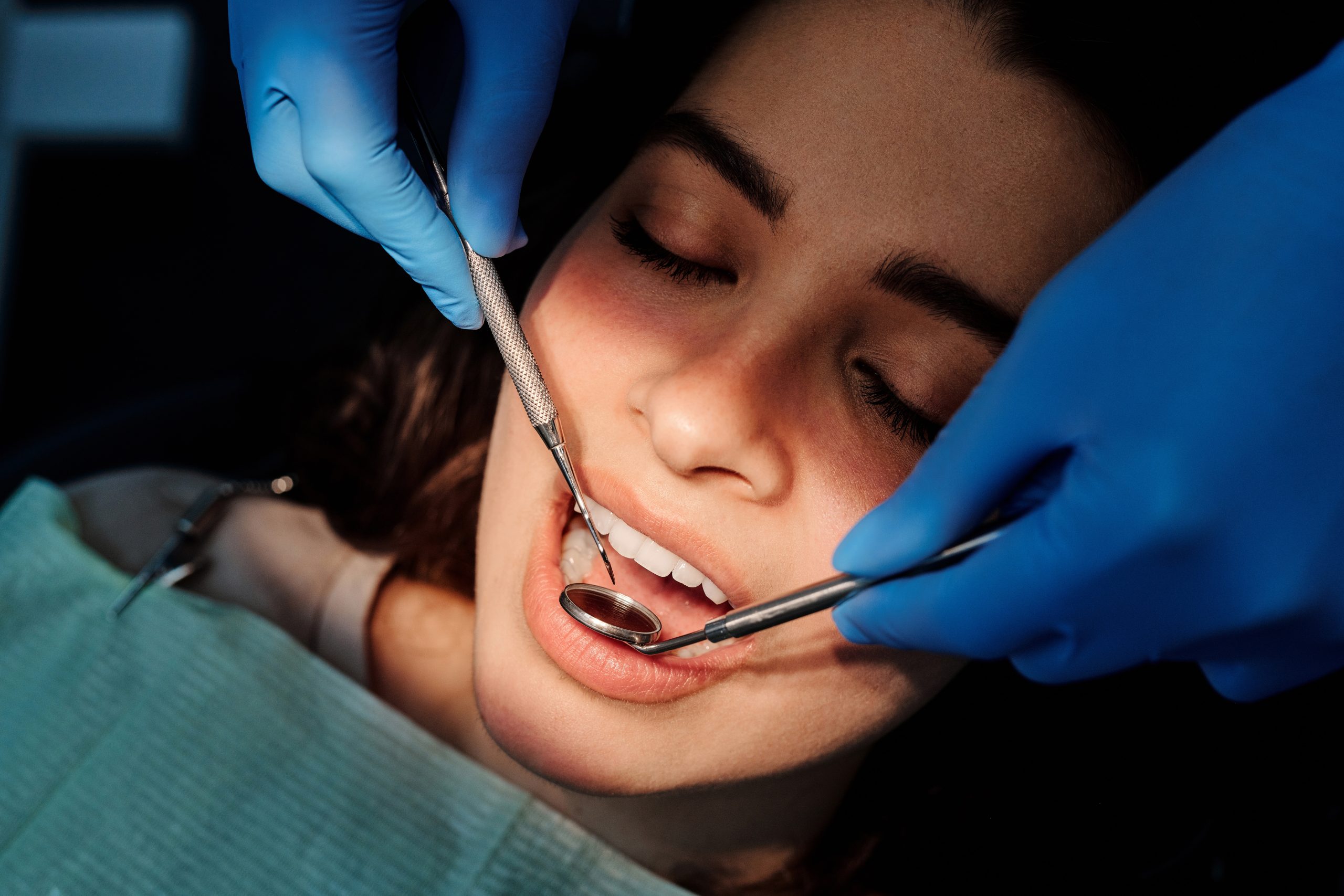
Before the procedure the operator assesses the X-ray – an orthopantomogram. Because this is a two-dimensional image, due to the possible overlapping of structures (for example a tooth and the mandibular canal), the operator may decide on additional CBCT imaging (cone-beam computed tomography), which presents the structures in three dimensions.
We come to the procedure healthy; in the event of a cold, we reschedule. Thanks to the local anaesthetic, the procedure itself is completely painless. Before the procedure it is necessary to eat a meal, as the numbness from the anaesthesia can last up to 4 hours after extraction and there is a danger of biting or burning the lip or tongue. The prick of the injection needle is painful, but once the anaesthetic is injected, the sensation of pain disappears. The operator then cleans the area around the mouth and covers the patient sterilely. The procedure itself follows. During the operation we feel dull pressure, but not sharp pain. The mucosa above the tooth is cut and moved aside. With a drill we remove the bone surrounding the tooth and free it. Then, with an elevator instrument, we loosen the tooth and, if possible, remove it with forceps. If necessary, the tooth is first cut into several parts. We also remove the sac surrounding the tooth and any inflamed tissue. We suture the wound; the stitches are removed after a week, or they dissolve on their own within six weeks. For half an hour after the procedure it is necessary to hold a swab on the wound.
The postoperative period – instructions after extraction and possible side effects
When the anaesthetic wears off, mild to moderate postoperative pain appears, lasting on average up to two days. It can be relieved with ordinary painkillers (for example paracetamol or non-steroidal anti-inflammatory drugs). Aspirin is not advised, as it prevents blood clotting. It is necessary to avoid alcohol and hot food.
Somewhat later than the pain, swelling may also appear, which is to be expected. It increases over the first three days, and within a week it is already almost imperceptible. Its appearance can be reduced by cooling the area of the face where the tooth was extracted and by eating cold food (for example ice cream).
Difficulty opening the mouth and swallowing, and a slightly raised body temperature (up to 38 °C), are entirely expected occurrences.
The wound will fill with blood, and within a few weeks the gum will grow over it. Within six months it will be completely covered with new bone.
After any surgical procedure, complications are possible, depending on the severity of the operation and the patient’s health and age.
- Heavy bleeding after the procedure is rare. By pressing a sterile swab directly on the wound, we usually stop it within half an hour. Some bloody saliva is possible on the same day.
- When we extract a heavily infected tooth and do not clean the wound thoroughly, stronger pain than expected can appear as early as the first day. This then requires reapplication of local anaesthesia and re-curettage of the wound. This means a longer healing time, but usually there are no lasting consequences. With a strongly raised temperature (above 38 °C), throbbing pain and spreading swelling, an immediate visit to the dentist is needed. This can mean the infection has spread to nearby spaces or bone (osteomyelitis).
- During a procedure in the upper jaw, a communication between the oral and the sinus cavity can occur. Smaller ones heal on their own; in that case it is necessary to avoid carrying heavy objects, blowing the nose, sneezing and drinking through a straw. With a larger communication, the dentist sutures the wound as tightly as possible and may prescribe antibiotic treatment. If a root or a whole tooth slips into the nasal space, or if the communication does not close, additional surgical treatment is needed.
- During a procedure on the back teeth in the lower jaw, injury to the nearby nerves can occur. Injury to the alveolar nerve shows up as a temporary disturbance of sensation or tingling in half of the lip. With injury to the lingual nerve, the sense of taste on the affected half of the tongue may be reduced. To restore function as quickly as possible, taking B-complex vitamins is recommended.
- During anaesthesia of the upper wisdom tooth, a feeling of difficulty breathing and swallowing can occur, which passes when the anaesthesia wears off.
- Relatively often after extraction of the lower wisdom teeth, a dry socket (alveolitis sicca) occurs due to the breakdown of the blood clot. This happens because of the influence of bacteria in the oral cavity, enzymes and the specific pattern of blood supply to the bone surface next to the root. The complication usually appears on the third day after the procedure. We recognise it by the return of pain, an unpleasant taste and bad breath, and an empty tooth socket. The pain usually spreads towards the ear and increases towards the evening. A visit to the dentist is then needed, who will insert an antiseptic and anaesthetic strip into the wound and prescribe pain therapy. The most effective preventive measure is not to rinse the wound and thereby wash out the blood clot, and to be careful when brushing teeth in the immediate vicinity of the wound.
- Cases of jaw fracture are extremely rare.
Healing is also significantly slowed by smoking, so it is not advised in the first week after the procedure. For general guidance on the operation and recovery you can also read the NHS advice on wisdom tooth removal. Interested in how smoking affects gum disease? Read more about periodontitis.
So when is the most suitable time to extract unerupted wisdom teeth?
Based on the medical history, clinical examination and assessment of the X-rays, the dentist will determine whether and when the extraction of unerupted wisdom teeth is necessary. The chances of an unerupted wisdom tooth erupting decrease significantly after the age of twenty, especially if there is a noticeable lack of space in the mouth or the X-ray shows an unfavourable (mesial) position of the wisdom tooth. With a periodontal probe, the dentist will check whether there is communication distal to the second molar with the unerupted wisdom tooth, which represents a retention site for food and bacteria. On the orthopantomogram, the dentist can assess the size of the dental follicle. If it is larger than three millimetres, this can indicate the potential for cyst development. Studies have shown that the most favourable time to extract asymptomatic wisdom teeth is between the ages of 18 and 19, when the bone is elastic and the roots are built to one third of their final length (when only the crown is present, the tooth is harder to grip, as it rotates in its socket). Extraction of asymptomatic wisdom teeth positioned lower in the lower jaw or higher in the upper jaw, and those lying near important anatomical structures, is not advised. Meanwhile, extraction of symptomatic teeth – most often partially erupted teeth – is always indicated. A tooth in the acute phase of problems is usually not extracted (an inflammatory focus). We then treat symptomatically (analgesics, antibiotics, incision and drainage) and wait for the problems to subside.
Frequently asked questions
When is the best age to have wisdom teeth removed?
Studies show the most favourable time to remove asymptomatic wisdom teeth is between the ages of 18 and 19, when the bone is still elastic and the roots are built to about one third of their final length. The chance of a tooth erupting on its own falls significantly after the age of twenty.
Does wisdom tooth removal hurt?
Thanks to the local anaesthetic the procedure itself is completely painless; you may feel dull pressure but not sharp pain. Only the initial prick of the needle is briefly uncomfortable. Mild to moderate pain lasting up to two days is normal once the anaesthetic wears off and can be eased with ordinary painkillers such as paracetamol.
What is a dry socket?
A dry socket (alveolitis sicca) occurs when the protective blood clot in the socket breaks down, most often around the third day after a lower wisdom tooth is removed. It is recognised by returning pain that spreads towards the ear, an unpleasant taste and bad breath. Avoiding rinsing the wound and brushing gently nearby is the most effective way to prevent it.
How long does recovery take?
Postoperative pain lasts on average up to two days, while any swelling peaks over the first three days and is almost imperceptible within a week. The gum grows over the wound within a few weeks, and new bone completely fills the socket within about six months.
Related reading
Ready for a healthy, confident smile?
Oral-surgery examinations and procedures with Albin Tahiri are available at OrthoDental Ljubljana–Situla.


Invisalign in Croatia vs Slovenia: price and treatment compared
A transparent comparison of Invisalign treatment in Slovenia and Croatia: published prices, travel, controls, refinements, retention and total cost.

Teeth whitening price | How much does teeth whitening cost?
How much does teeth whitening cost? See OrthoDental’s exact price list for professional teeth whitening, with transparent, no-surprise pricing.
How to prevent gum recession? Causes, symptoms and treatment
Gum recession can lead to serious dental problems, but with early action and consistent prevention you can keep your gums healthy.
