


For many people, fixed braces are still the first thing that comes to mind when they think of orthodontic treatment. That is logical. It is a method that has been around for decades, almost everyone knows it, and it is used for a very wide range of irregularities, from minor misalignments to more demanding bites. On this topic, patients usually look for very concrete answers: what types exist, how much treatment costs, whether braces can be obtained through a referral, how long the waiting times are, and whether there is a more comfortable option today with the same goal.
The first part of this article is dedicated to fixed braces as a treatment method. The second part explains self-pay options, treatment through the public system, and the question of treatment in Croatia with the possibility of cost reimbursement when the conditions are met. At the end there is an explanation of why we do not provide fixed braces at OrthoDental and why today, for many cases including more demanding ones, we use Invisalign as a more modern and comfortable path to the same orthodontic goal. OrthoDental is focused on Invisalign treatment, and for children also on Invisalign First during the growth period.
- Fixed braces use brackets and an archwire to move the teeth gradually, and can treat a very wide range of irregularities.
- In self-pay treatment the usual choice is between metal and ceramic braces – the difference is mainly appearance, comfort and price, not effectiveness.
- Treatment on a referral is possible only when the professional and insurance criteria are met, and waiting times can be long.
- OrthoDental does not fit fixed braces – we focus on Invisalign, and on Invisalign First for children, which can treat many cases, including more demanding ones, with fewer everyday restrictions.
If you want to know more about whether to choose Invisalign or braces, read more here: Invisalign or braces.
Book an orthodontic examination
What are fixed braces and how do they work
Fixed braces are an orthodontic appliance attached to the teeth that works continuously. This means the patient cannot remove it themselves; it stays in the mouth throughout the treatment. Brackets are placed on the teeth, and the orthodontist guides a wire (archwire) through them. This creates controlled forces that gradually move the teeth into the planned position. For an independent overview of orthodontic treatment and braces, see the NHS guide to orthodontics.
This is the basic logic of fixed braces. They do not move all the teeth at once without order, but gradually guide individual teeth and the entire bite toward the state the orthodontist defines at the start of treatment. Because of this they are used for a very wide spectrum of irregularities. This can include crowding, gaps, rotated teeth, deep bite, open bite, crossbite or more demanding relationships between the upper and lower jaw. That is also why fixed braces are still such a recognisable part of orthodontics.
The main parts of fixed braces
Classic fixed braces consist of brackets, an orthodontic archwire, and various additional elements that help direct the movements. Some systems also use elastic bands that help hold the wire in the bracket or serve for additional movements between the upper and lower jaw.
Patients most often notice the brackets and elastics, because those are the most visible parts of the appliance. For the success of treatment, however, the whole system together with regular check-ups is decisive, as the orthodontist adjusts the appliance according to how the teeth are moving.
Which problems it is used for
Fixed braces are used for very different irregularities. This includes tightly arranged teeth, larger gaps between teeth, incorrect position of individual teeth, upper teeth that protrude too far, crossbite, deep bite and other forms of incorrect contact between the upper and lower jaw.
This is also the reason many people still perceive fixed braces as a universal solution. In the past they were practically the obvious choice for many cases. Today the picture is broader, because clear aligners have advanced considerably, but fixed braces as a method remain an important part of orthodontic history and a well-known reference for patients.
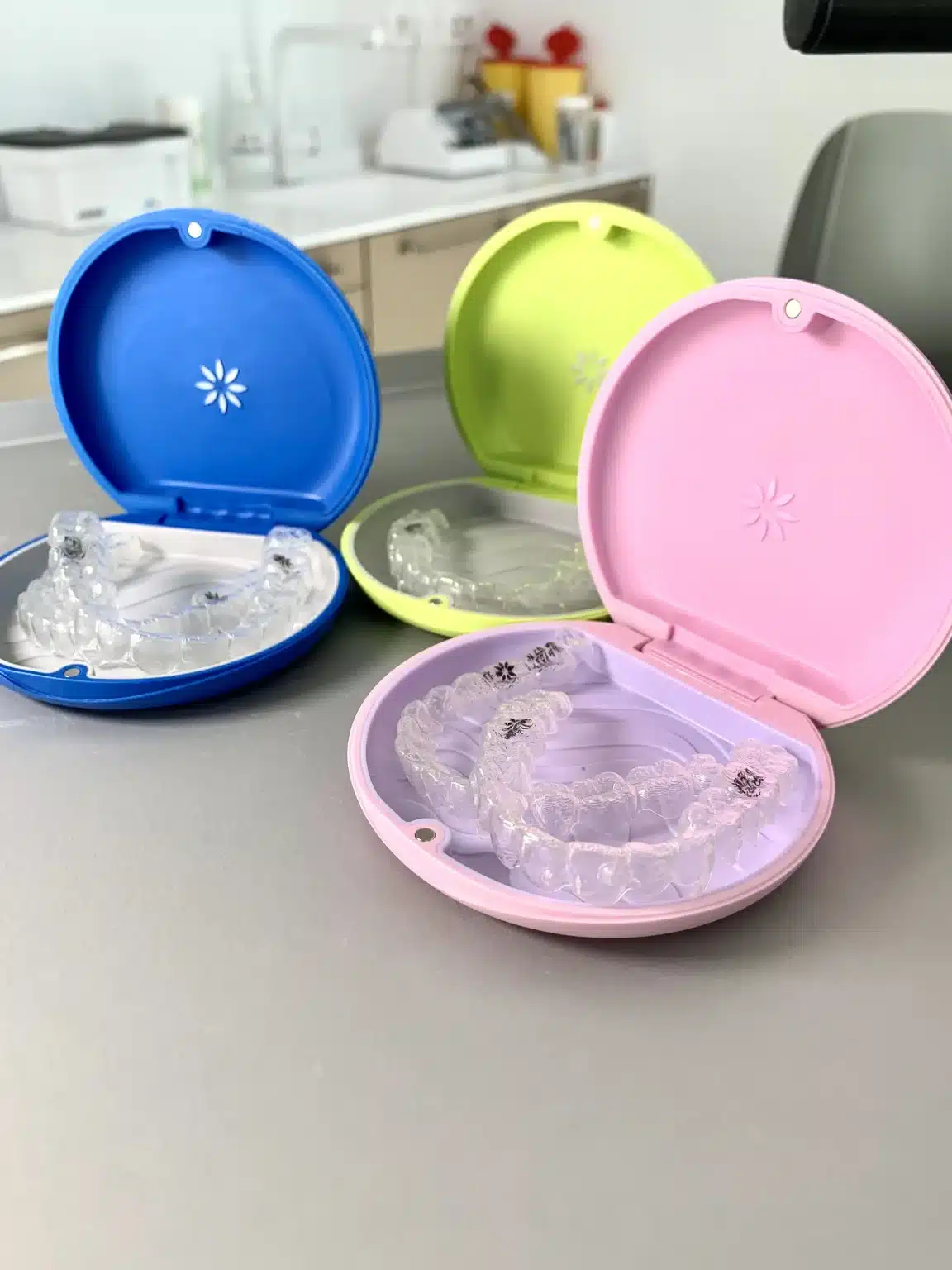
Types of fixed braces
When people search for the term fixed braces, they have different versions in mind. Fundamentally we are talking about the same treatment method, but the appliances differ in appearance, material and everyday feel.
The most common choice in self-pay treatment is still between metal and ceramic fixed braces. The difference between them is not that one necessarily treats better than the other. The difference is mainly in appearance, partly in comfort and often in price.
Metal fixed braces
Metal fixed braces are the most classic form. The brackets are metal, so the appliance is more noticeable. On the other hand, it is often a more affordable solution and a version patients know well.
Many children and teenagers feel good with metal braces precisely because they are the most recognisable. They are not hidden, not neutral and do not need to be concealed. For younger patients this is often not a drawback but part of the orthodontic treatment experience.
Ceramic fixed braces
Ceramic braces work by the same logic, but the brackets are made of a lighter material, so they blend in more with the colour of the teeth. Because of this the appliance is less noticeable, and adult patients often perceive it as a more aesthetically acceptable option than metal.
This choice is usually also associated with a higher price. For many people this is exactly why they choose between ceramic braces and clear aligners, since both address the same motive: a less visible orthodontic appliance in everyday life.
Coloured elastics and the look of the appliance
With classic fixed braces, patients can often choose the colour of the elastics. This is especially popular with children and teenagers, who also experience the appliance as something personal. The colours can be changed at check-ups, so some make almost a routine of it, linked to the season, holidays or simply their mood.
For adults this is usually not the main reason for choosing the method, but for younger patients it can be an important detail. The appliance can thus be at least partly adapted to appearance, even though it remains clearly visible.

How treatment with fixed braces works
Treatment with fixed braces does not begin with bonding the brackets, but with diagnostics. The orthodontist must first accurately assess the bite, the position of the teeth, the condition of the gums, the spatial relationships in both arches and the relationship between the jaws. Without this it is not possible to determine a good plan.
Once the plan is made, the appliance is fitted. After fitting, most patients feel pressure and sensitivity for the first few days. This is an expected part of the beginning, because the teeth start to respond to the forces. Later, treatment proceeds through regular check-ups, at which the orthodontist checks progress and adjusts the appliance.
First examination and orthodontic diagnostics
At the first examination the orthodontist usually assesses the bite, the position of the teeth and the whole orthodontic picture. Depending on the case, photographs, X-ray diagnostics and impressions or a digital scan of the dental arches may follow. The goal is not only to answer whether treatment makes sense, but also which method is most suitable for a given case.
This is also the moment when the patient learns whether it is a minor aesthetic correction or treatment that will affect several levels of the bite. In orthodontics this difference is important, because it affects the duration, course and cost of treatment.
Fitting and the first weeks after fitting
Once the appliance is fitted, the patient has to get used to it. For most, the first days involve tooth sensitivity, slightly harder biting and a feeling of a foreign object on the inner side of the lips and cheeks. This is not a sign that something is wrong with the appliance, but a usual response to the new situation in the mouth.
For some patients the initial adjustment is faster, for others it takes longer. Most of the discomfort is usually not related to pain in the true sense, but to a feeling of pressure and mechanical irritation of the mucosa until the mouth gets used to the appliance.
Check-ups and care during treatment
Fixed braces require regular check-ups. At these the orthodontist monitors tooth movement, changes or adjusts the wire and adds elastics or other elements if needed. This means treatment is not something that runs on its own after fitting without the patient participating.
Cooperation with fixed braces is also very important at home. Hygiene must be precise, because food is more easily retained around the brackets and wires. In addition, certain foods become problematic because they can damage the appliance or make cleaning harder. For many this is not a decisive minus, but it is a real part of everyday life during treatment.
| Case type | What it corrects | Typical duration |
|---|---|---|
| Minor | Small crowding or gaps | 3–8 months |
| Moderate | Bite & alignment issues | 9–12 months |
| Complex | Significant misalignment | up to ~15 months |
The self-pay price of fixed braces
The self-pay price of fixed braces is not uniform. It differs between clinics and depends on the complexity of the case, the type of appliance and the scope of treatment. A patient therefore struggles to get a meaningful answer with just one number, without an examination and without a plan.
That is exactly why, when comparing offers, it is important to look at the bigger picture. A low starting price does not necessarily mean a lower final cost if it does not include check-ups, additional materials or retention after treatment. In orthodontics you should always ask what the price actually covers.
What the price depends on
Several factors influence the price. The first is the type of appliance, since ceramic is usually more expensive than metal. The second is the complexity of the case. The greater the movements needed and the more complex the bite, the longer and more demanding the treatment. The number of check-ups, any additional procedures and the method of retention after the end of active treatment also play an important role.
When comparing methods it is useful to know one more thing. With clear aligners the price is also not uniform, but tied to complexity. This is important above all because the patient is not comparing just the “appliance”, but the entire method of treatment and what they actually get for their investment.
What to ask at the first consultation
At the first consultation it makes sense to ask four things. Whether the price is final or approximate. Whether all check-ups are included. Whether retainers after the end of treatment are included. And how payment is arranged.
These questions are not a formality. They are essential for a fair comparison between offers. Patients often focus on the first number rather than on the entire scope of the service. That is exactly where the difference between a seemingly cheaper and an actually more sensible choice can show.
Fixed braces on a referral and waiting times
A large part of the interest in keywords related to fixed braces comes from the question of whether orthodontic treatment can be obtained through a referral. The answer depends on professional assessment and the rules of the system. Eligibility is not something a patient decides for themselves, but is tied to orthodontic judgement and to the rights arising from compulsory health insurance.
The other part of this topic is waiting times. These can be very long, so many parents and adults start researching self-pay options or treatment abroad. The biggest mistake in orthodontics is often waiting too long for an examination, hoping everything will move quickly through the public system. When it turns out the deadlines are very long, a lot of time may already have been lost. The current waiting time at a particular provider is checked in the official waiting-times system, as this data changes.
Who can be a candidate for treatment through the public system
On this topic the most honest thing to say is the following: a candidate for treatment through the public system is not everyone who would like an appliance, but someone who meets the professional and insurance conditions. This means the orthodontist first judges whether it is an irregularity that falls within the scope of rights arising from compulsory health insurance.
That is why the first orthodontic examination is also important for patients considering treatment on a referral. Without an examination it is not possible to know whether it is a case eligible for such treatment at all.
Why patients often look for self-pay options
The main reason is time. When waiting times are long, many patients want to start treatment sooner. For some the reason is also greater flexibility. Self-pay treatment allows a wider choice of approach, appointments and treatment method.
For adult patients, however, something else is often at the forefront. They are not just looking for an orthodontic correction, but a way that will disturb daily life, work, appearance and oral hygiene as little as possible. This is where the comparison between fixed braces and Invisalign opens up.

The option of treatment in Croatia and the question of reimbursement
Orthodontic treatment abroad is not uncommon. For Slovenian patients, Croatia is often the first option, mainly due to proximity, accessibility and the feeling that an appointment is easier to get. However, on this topic it is important to distinguish between self-pay treatment abroad and reimbursement of costs from the Slovenian system.
Orthodontic treatment abroad can be a basis for cost reimbursement if the conditions are met. One such case is that you have a previously issued referral in Slovenia and carry out the treatment in another EU member state. In this case you usually pay the costs yourself first, then submit a claim for reimbursement. Costs are usually reimbursed up to the average price of these services in Slovenia, at most up to the actual costs, while travel and accommodation are usually not included.
Another important framework is planned treatment abroad because the permissible waiting times have been exceeded or treatment options in Slovenia have been exhausted. In these cases the procedure is different and approval from the ZZZS (Health Insurance Institute of Slovenia) may be required. Always check the current rules and specific documentation before starting treatment, not after.
Why patients decide on treatment abroad
The most common reason is faster access. The second is the feeling that self-pay treatment abroad will be simpler to organise. In border regions practicality also plays a role, since for some the journey to a clinic in Croatia is shorter than to certain centres in Slovenia.
This does not mean cost reimbursement will be automatic. Rules exist, but they must be checked before treatment begins, not after. For such a decision it is not wise to rely on an acquaintance’s experience, but on the current rules and specific documentation.
What to check before starting treatment abroad
Before deciding on treatment in Croatia or elsewhere in the EU, it makes sense to check four things. Whether it is a service that is a right from compulsory health insurance in Slovenia. Whether the patient has an appropriate referral. Whether prior approval is required for the chosen case. And what documentation will need to be submitted to the ZZZS after treatment.
This is not a bureaucratic trifle, but the difference between an orderly procedure and a situation in which treatment was carried out but reimbursement is then not possible or is considerably lower than expected.
Disadvantages of fixed braces in everyday life
Fixed braces can be very effective, but they are not particularly gentle on everyday life. This is part of the topic that patients often start thinking about seriously only after treatment begins. As long as the appliance remains an abstract idea, only the result is in focus. Once it is in the mouth, hygiene, diet, appearance and the feeling when speaking also become very concrete.
For exactly these reasons, many patients today no longer ask only whether fixed braces are effective. They ask whether they are still the most sensible choice for them personally.
Hygiene and cleaning
With fixed braces, oral hygiene is more demanding. Food is more easily caught around the brackets and under the wire, so cleaning requires more time and precision. This is especially important for patients who are already less consistent with dental care.
In practice this means more discipline every day. Not just occasionally, but after every meal when possible. For some patients this part becomes a greater burden than they expected at the start.
Comfort, appearance and diet
Fixed braces cannot be removed. This means they remain visible when speaking, laughing, in photos and at work. For some this does not matter. For others it matters a lot.
The same applies to diet. Certain foods become impractical or increase the chance of the appliance being damaged. Add to this occasional irritation of the cheeks and lips and a feeling of pressure after check-ups. None of these things is unusual. But they are the reason many patients today actively look for a different option.
Book a free Invisalign consultation

At OrthoDental, the path to straighter teeth looks a little different from the appliance described above.
A modern alternative: Invisalign instead of fixed braces
Here we come to the point where it is fair to say very clearly: at OrthoDental we do not provide fixed braces. Our clinic is focused on Invisalign treatment, because we believe that today’s orthodontics allows the same goal for a very wide spectrum of cases without metal brackets and wires.
This does not mean fixed braces are not a good solution. It means that today they are no longer the only serious option. For many cases the patient can reach the same goal in a different way, with fewer limitations in everyday life. Once they understand this option, they often no longer ask whether fixed braces are the classic solution, but whether they are still the most sensible solution for them personally.
Why we do not use fixed braces at OrthoDental
The reason is not marketing, but clinical and practical. Our approach is based on digital planning, a predictable course and greater comfort for the patient. Invisalign allows us to run treatment with clear removable aligners, which for the patient means fewer disruptions to hygiene, fewer dietary restrictions and a much less noticeable course of treatment. OrthoDental is also focused on treating children during the growth period with Invisalign First, and on treating more demanding cases in adolescents and adults with Invisalign.
It is also important to us that the patient does not feel during treatment as though they have to live around the appliance every day. With fixed braces the patient adapts to the appliance. With clear aligners everyday life is usually much less burdened.
Can the same results be achieved with Invisalign?
In many cases yes, even in demanding cases. This is the essential point of this article. Invisalign is not a softer aesthetic version for less serious problems, but a method used for a very wide spectrum of orthodontic conditions, from simple movements to more complex cases. OrthoDental also uses Invisalign for more demanding orthodontic irregularities in adolescents and adults.
The key difference is therefore not necessarily in the final result, but in the path to that result. With good planning the goal can remain the same: aligned teeth, an orderly bite and a stable outcome. What changes is the user experience during treatment.
Advantages of Invisalign compared with fixed braces
The biggest advantage is removability. The patient removes the aligners while eating, so there are no dietary restrictions such as those typical of fixed braces. Hygiene is also easier, because the teeth are cleaned without brackets and wires.
The second advantage is appearance. Clear aligners are much less noticeable than fixed braces. The third is comfort. Without brackets and wires there is less mechanical irritation of the lips and cheeks.
For many patients the combination of these three things is decisive. They are not looking only for an orthodontic solution, but a solution that lets them eat, maintain hygiene, work, speak and laugh normally without feeling that the appliance has taken over everyday life.
How to know which solution is right for you
A good choice of orthodontic method is not a question of habit, but a question of the match between the clinical picture and the patient’s life. One person will be willing to accept the limitations of fixed braces without particular difficulty. Another will want to achieve the same goal in a less visible and less burdensome way.
The decision must be based on an examination. Only then is it possible to realistically assess how demanding the case is, what result can be expected and which path will lead to that result most sensibly. In modern orthodontics the question is therefore no longer only whether to have an appliance, but also which form of treatment will be best for me.
Frequently asked questions about fixed braces
Are metal braces better than ceramic?
Not necessarily. Both serve the same basic goal. The difference is mainly in appearance and often in price. Metal is more visible, ceramic less.
Can the colour of the elastics be changed with fixed braces?
Yes. With many classic appliances you can choose a different colour of elastics at check-ups.
Can orthodontic treatment be obtained through a referral?
Yes, but not for every case. Eligibility is tied to professional assessment and the rules of compulsory health insurance.
Are the waiting times for an orthodontist long?
They can be very long. Current data is checked in the official waiting-times system, because it differs between providers and changes over time.
Is it possible to be treated in Croatia and claim reimbursement?
In certain cases yes, if the conditions under ZZZS rules are met. What matters is whether you have a referral, whether it is a service covered by compulsory insurance and whether prior approval is required.
Can the same results be achieved with Invisalign as with fixed braces?
In many cases yes, even in more demanding ones. The difference is mainly in the method of treatment and in comfort during treatment.
Ready for a healthy, confident smile?
Book an Invisalign consultation at one of five OrthoDental locations in Slovenia.


Instructions for successful Invisalign treatment
Congratulations, you have become the new owner of Invisalign invisible dental appliance. This is the first step to straight teeth and a more beautiful smile. In order to achieve the most successful and fast results, we have prepared for you some instructions regarding the use of Invisalign aligners and answers to your questions.

When should you first take a child to the orthodontist?
A first orthodontic examination is recommended around age 6, when the orthodontist can assess the bite, jaw growth and space for permanent teeth. An early check-up allows timely monitoring or treatment.
Apicoectomy: root-end surgery to help save a tooth
Understand when an apicoectomy may help save a root-treated tooth, how the procedure works, recovery, alternatives and when to seek advice.
