


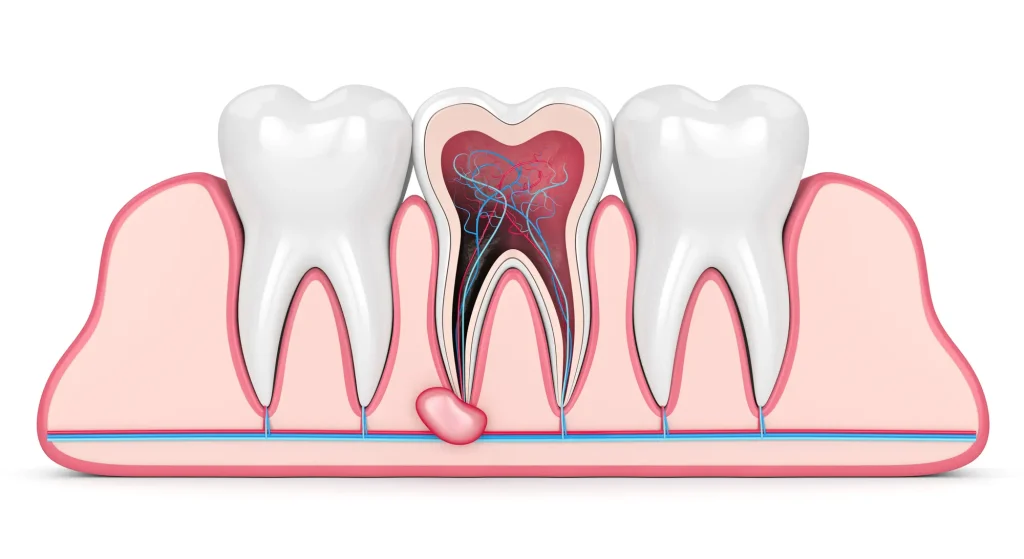
A dental granuloma is swelling and inflammation of the tissue around a tooth, forming around the root of the tooth nerve and usually the result of deeply advanced tooth decay or other problems with the tooth’s root canals. For years it may go unnoticed, but when your resistance drops, problems such as swelling and pain can appear.
- A granuloma is a chronic inflammation at the tip of a tooth root, often painless at first and seen on an X-ray as a darker area.
- The usual cause is deep decay reaching the tooth pulp; a granuloma typically takes around six months to form.
- Root canal (endodontic) treatment resolves a granuloma in more than 90% of cases; a badly affected tooth may need extraction and a dental implant.
What is a dental granuloma?
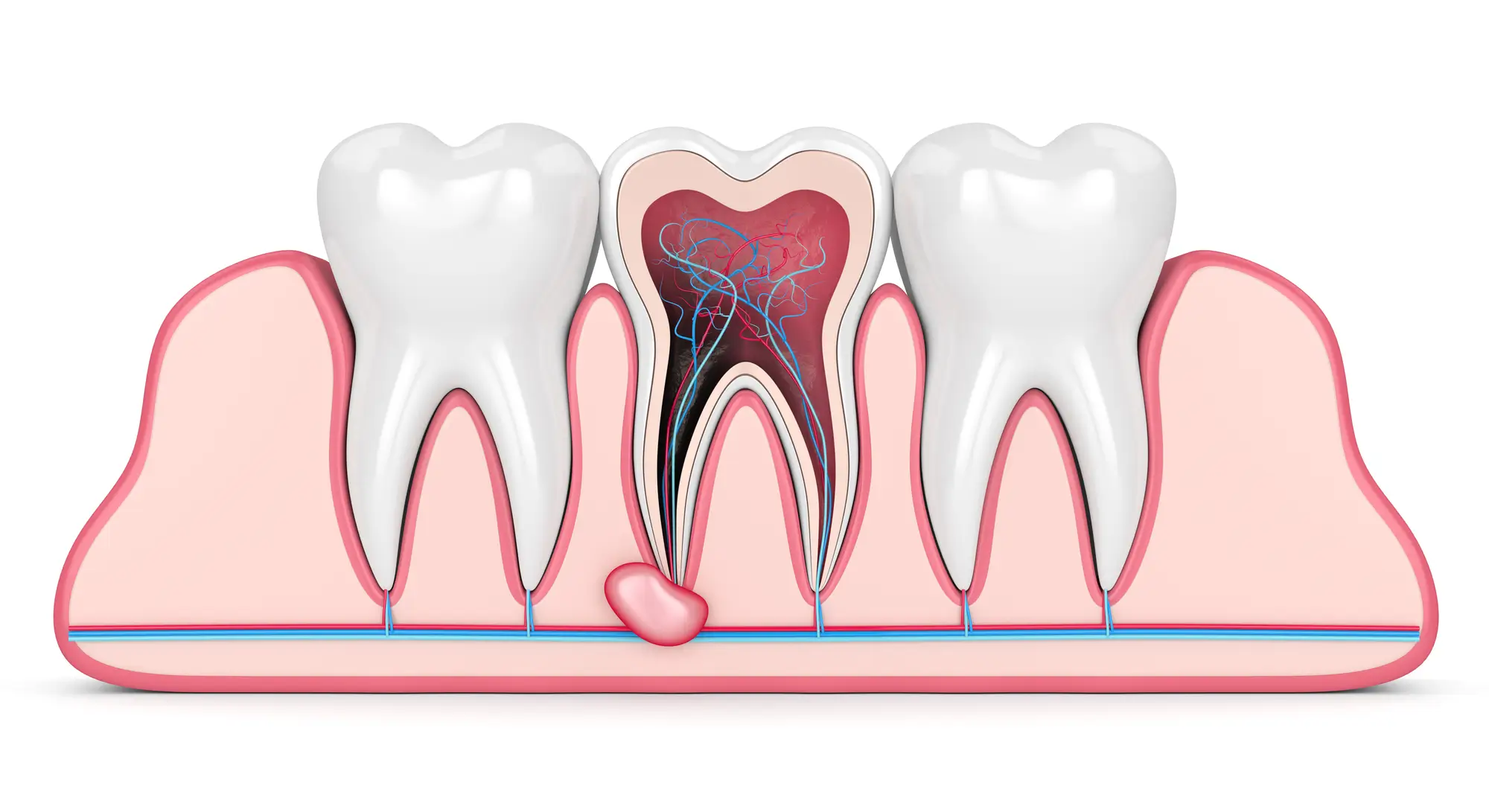
A dental granuloma appears when infection spreads into the tooth roots. It is a small bulge at the tip of the tooth root, which at first is often symptom-free and can therefore go unnoticed. A granuloma forms as the body’s defence mechanism, when bacteria accumulate around the tooth root and cause inflammation.
The immune system plays a key role, as it tries to contain the spread of infection when bacteria accumulate and cause inflammation in the inner part of the tooth nerve. Although a granuloma may not seem like a big problem at first, the long-term presence of infection can lead to more serious complications, so it is important to recognise and treat it in time.
On an X-ray, a dental granuloma appears as a darker area around the tip of the tooth root.
Symptoms of a granuloma
The first signs of a granuloma are often very inconspicuous. They may show as slight tingling or mild pain in the gum that points to an inflammatory process. You may also notice gradual darkening of the tooth, bad breath with a rotten smell, minor swelling and sensitivity of the tooth when biting and to heat and cold.
A granuloma can also form for other reasons, for example an old and worn filling, a worn-out prosthesis or a cracked dental crown. Sometimes it appears when previous treatment of the tooth nerve was unsuccessful.
In some cases a granuloma manifests as a fistula, where pus-like fluid is discharged from the gum. Not all signs are always present at once, and sometimes a granuloma causes no pain at all, yet chronic inflammation is still taking place in the background.
If you notice any of these symptoms, visit the dentist as soon as possible so the correct diagnosis can be made and appropriate treatment carried out. With modern dental procedures, dentists often successfully treat inflammation of the tooth nerve and prevent or cure granulomas.
| Step | What happens |
|---|---|
| Diagnosis | X-ray and assessment |
| Cleaning | Infected pulp removed |
| Filling | Canal sealed |
| Restoration | Crown or filling placed |

Why does a granuloma form?
The cause of a granuloma is usually very deep tooth decay that reaches the tooth pulp (the tooth nerve) – first in the visible part of the tooth (the crown), and then spreading to the ends of the tooth roots in the bone. That is why it is so important to begin treating the tooth and removing the decay as soon as possible.
Besides deep decay, a granuloma can be caused by other problems, such as tooth injury from a blow, orthodontic treatment, an unlucky bite on a hard object, old and worn fillings, worn prostheses or damaged dental crowns. It can also form when previous root canal treatment was unsuccessful. A granuloma usually needs around six months to form.
The stages in which a granuloma forms
The formation of a granuloma can be divided into several stages. It usually begins as deep inflammation of the tooth pulp. In the next phase, the inflammation spreads through the root canal into the bone and surrounding tissue, which can lead to a granuloma. This is a gradual process that can develop over several months.
What are the consequences of an untreated granuloma?
An untreated granuloma can cause several serious consequences:
- Bone loss: a long-term inflammatory process within the jaw can lead to the breakdown and loss of surrounding bone.
- Pain: a granuloma can cause constant or occasional pain in the area around the tooth, which can intensify and become very disturbing.
- Cyst formation: sometimes a granuloma develops into a cyst, similar to a small balloon on the gum near the affected tooth, which can occasionally discharge pus-like fluid.
- Spread of infection: if the infection is not controlled, it can spread through the body and affect general health.
- Limitation of dental options: an advanced granuloma can complicate or even rule out certain procedures, such as saving the tooth with root canal treatment or placing dental implants.
It is important that a granuloma is recognised and treated as soon as possible to prevent serious consequences. Regular dental visits and timely treatment are crucial for keeping your teeth and mouth healthy.

How is a granuloma treated?
Treatment usually depends on the cause and location, and dentists focus on addressing the underlying condition. It may include medication such as antibiotics or anti-inflammatory drugs, and in some cases surgical removal of part of the tooth root. The procedure is one of the more demanding in dentistry and takes considerable time and skill, so it makes sense for it to be handled by an endodontist – a dentist who has specialised in treating the tooth pulp. When a tooth is severely inflamed, extraction and replacement with a dental implant is also possible, giving you the same feeling as your natural teeth.
What is endodontic treatment?
Endodontic treatment is a therapeutic procedure on the root canals involving removal of the inflamed nerve and infected tissue, plus mechanical and chemical cleaning of the canal, which also treats a dental granuloma. Successful treatment requires extensive knowledge and experience and takes time; precise, thorough cleaning is crucial so the root canal is left perfectly clean. For an independent overview, see the NHS guide to root canal treatment.
How does endodontic treatment work?
The dentist or endodontist removes the inflamed or dead tooth pulp and bacteria from one or more root canals. These canals run from the tooth crown to the tips of the roots, where they open towards the bone through a small opening – the area where a granuloma often forms.
Using hand and special machine instruments, the dentist slightly widens the canal and removes any remaining infected tissue. The canals are then cleaned with disinfectants, and a medicine is placed inside, based on calcium hydroxide or an antibiotic paste.
After a certain time this medicine is replaced and, if treatment has been successful, the tooth can be sealed. If it was not successful, the procedure is repeated.
Is granuloma treatment always successful?
Endodontic (root canal) treatment is successful in more than ninety percent of cases. With proper care and regular maintenance, a “dead” tooth can be preserved for as long as a healthy one.
If the initial treatment is not successful and the X-ray shows the granuloma has not disappeared, the whole procedure needs to be repeated. Sometimes tooth loss can still occur.
Possible complications in granuloma treatment
Some complications can occur when treating a dental granuloma:
- Recurrence: a granuloma can reappear if the infection was not completely removed or the inflammation returns.
- Abscess: a pus-filled formation can develop around the tooth root, causing severe pain and swelling.
- Root perforation: the wall of the tooth root can be accidentally perforated, making the tooth harder to treat and preserve.
- Damage to adjacent structures: surrounding tooth tissue, gums or the jawbone can be affected during treatment.
- Discomfort and pain: some discomfort after treatment is normal and usually settles within a few days; more prolonged pain is rare.
Discuss the possible risks with your dentist before deciding on root canal treatment, and follow the aftercare instructions to reduce the chance of complications.
How to prevent a granuloma from forming
The best way to prevent tooth decay, inflammation of the tooth pulp and granuloma is good oral hygiene. Regular tooth brushing, flossing and mouthwash help keep teeth healthy. Visit the dentist for regular check-ups too, as early decay often causes no noticeable symptoms while the dentist can still act in time. A healthy diet and a strong immune system also help. When a granuloma progresses to a more severe form, an apicoectomy (surgical removal of the root tip) may be needed.
Frequently asked questions
Is a dental granuloma dangerous?
A granuloma is a sign of chronic infection at the root tip. It is often painless at first, but left untreated it can lead to bone loss, cyst formation, an abscess or spread of infection, so it should be assessed and treated promptly.
Can a granuloma be treated without extracting the tooth?
Yes. In most cases root canal (endodontic) treatment clears the infection and saves the tooth, with success in more than 90% of cases. Extraction and a dental implant are considered only when the tooth cannot be preserved.
How long does a granuloma take to form?
A granuloma usually needs around six months to develop, growing gradually from deep inflammation of the tooth pulp as the infection spreads through the root canal into the surrounding bone.
Ready for a healthy, confident smile?
Book a dental examination in Ljubljana or Kozina.


Fixed braces | Everything you need to know about braces
Fixed braces are the classic orthodontic solution, available in metal and ceramic versions. This article explains the types, price, waiting times, treatment abroad and how they compare with Invisalign.
Invisalign price | How much does Invisalign cost?
Current Invisalign prices in Slovenia: €2,500 for Invisalign Small in both arches, €4,000 for Comprehensive treatment, Invisalign First phases at €2,700 and €3,250, and a free first consultation.

Endodontics – root canal treatment
Endodontics deals with diseases of the dental pulp. Learn when root canal treatment is needed, how it is performed, its success rate, and what recovery looks like.
